Heads up: this guide contains an affiliate link. If you buy through it we earn a small commission at no extra cost to you.
Tannat is the most tannic red grape in the world, and the name is not a coincidence. It comes from Madiran in the foothills of the French Pyrenees, where the locals have been making black, mouth-gripping wine from it for centuries and where, according to one much-quoted study, the men live unusually long lives. Scientists blamed the wine. The locals did not argue.
Then Basque immigrants carried it to Uruguay in the 1870s, and the small South American country made Tannat its national grape, softer and fruitier than in France and increasingly excellent. It is the underdog red that rewards patience, a decanter and a large piece of beef.
Table of Contents
What Does Tannat Taste Like?
Blackberry, black plum, blackcurrant and dried fig, with dark chocolate, liquorice, smoke, tobacco and a whiff of leather. It is inky black, full-bodied, extremely high in tannin and firm in acidity. Young Madiran can be a wall; Uruguayan Tannat is riper and rounder; both age into something velvety and complex.
| Aspect | Rating out of 5 | Characteristic |
|---|---|---|
| Sweetness | 🍷 | Dry, and then some |
| Body | 🍷🍷🍷🍷🍷 | Full and dense, a Pyrenean heavyweight |
| Tannins | 🍷🍷🍷🍷🍷 | The most tannic grape on Earth; the name is the warning |
| Acidity | 🍷🍷🍷🍷 | Firm, which helps it age |
| Alcohol by Volume | 🍷🍷🍷🍷 | Typically 13.5–14.5% |
Each wine glass icon is one point on a 5-point scale: one glass is low, five is high, based on the grape’s typical style.
Where It Grows
Madiran in south-west France is the birthplace, where the wine must be at least 60 percent Tannat and the best producers use a technique called micro-oxygenation, invented there, to tame the tannins. Uruguay now has more Tannat than France and makes the most approachable versions, especially around Canelones and Montevideo. Argentina, Brazil and California grow a little.
Australia has a small Tannat community, mostly in warm regions where it ripens fully: the Barossa, McLaren Vale, the Riverland and Queensland’s Granite Belt, where it has become something of a local speciality. Australian Tannat tends to be riper and friendlier than Madiran, and it is one of the few reds that can stand up to our biggest steaks.
How to Serve It
Temperature: 16–18°C.
Glass: the largest Bordeaux bowl you have; see the glasses roundup.
Decanting: essential. Two hours in a decanter for young bottles, or an aerator in an emergency. Our Riedel Cabernet decanter review covers a suitable vessel.
Ageing: Madiran needs five to ten years and can go thirty. Uruguayan and Australian Tannat drinks earlier but still improves for a decade.
What to Eat With It
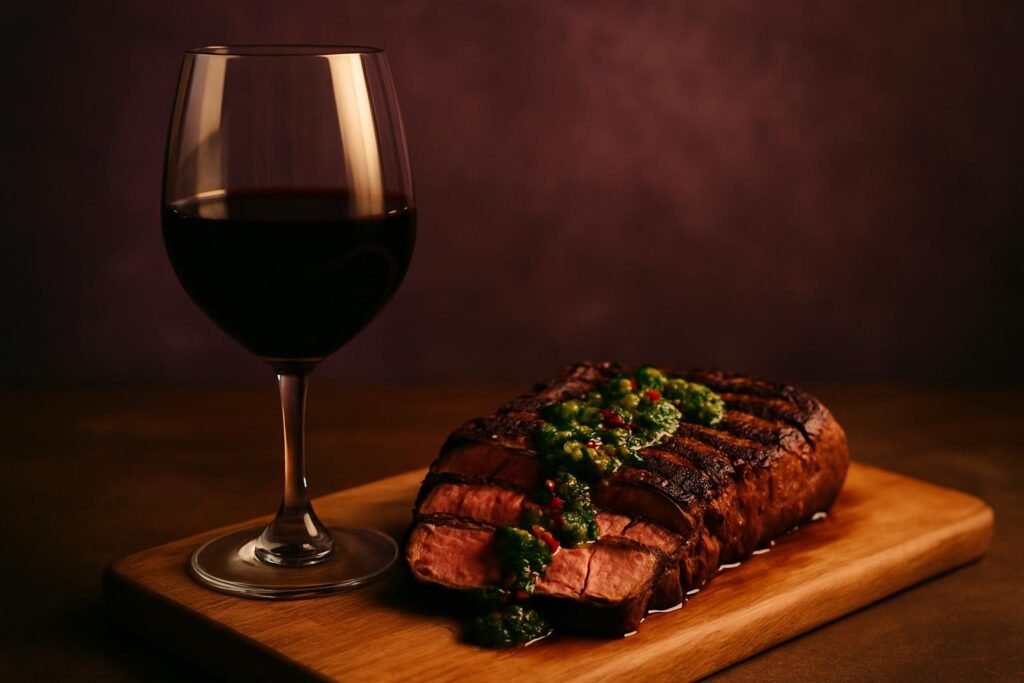
Beef, beef and more beef: steak, short ribs, brisket and Uruguayan-style asado. Cassoulet, duck confit, goat, game and bacon-rich dishes all suit it. Hard aged cheeses at the end. Nothing light need apply. More in the pairing guides.
Celebrated Wine Labels
| Wine Label | Country | Style |
|---|---|---|
| Château Montus | France | Alain Brumont’s Madiran, the modern benchmark |
| Domaine Berthoumieu | France | Traditional Madiran, old vines |
| Bodega Garzón | Uruguay | The country’s flagship, polished and ripe |
| Pisano | Uruguay | Family estate, characterful Tannat |
| Symphony Hill | Australia | Granite Belt, Queensland’s Tannat specialists |
Can’t Find One? Drink This Instead
Honesty corner: our partner shop had no Tannat in stock when we checked. The closest match on the shelf is a structured Cabernet Sauvignon: firm tannin, dark fruit, a need for a decanter, and the same appetite for a steak.

Tamburlaine Central Ranges Organic Cabernet Sauvignon 2024
Not Tannat, but a structured organic Cabernet is the nearest thing to a Madiran dinner on the shelf. When a Tannat lands in stock, it takes this spot.
- Firm, dark and structured, the same job Tannat does with a steak
- Certified organic from an Australian organic pioneer
- Beef, lamb and hard cheese all work
- Under twenty dollars
- Far softer than a real Tannat; you will survive without a decanter
New to Just Wines? The code FIRST20 takes $20 off a first order over $99, so it is worth building a mixed six rather than buying the one bottle. New customers only, and the offer can change without notice.
Frequently Asked Questions
Is Tannat the most tannic wine?
Among major grapes, yes. It has more tannin-forming compounds in its skins and seeds than almost any other variety, which is why young Madiran is so gripping and why it ages so well.
Is Tannat good for your health?
It is high in procyanidins, the compounds linked to heart health in red wine, and Madiran’s longevity statistics made headlines. But it is still wine; drink it for the taste, not the pharmacy.
What is Tannat similar to?
Cabernet Sauvignon and Petit Verdot for structure, Malbec for its south-west French roots, and Aglianico for sheer tannin. Read our Cabernet Sauvignon guide for the nearest match.
Why is Tannat Uruguay’s national grape?
Basque settlers brought it in the 1870s and it thrived in Uruguay’s maritime climate. The country now grows more Tannat than France and has built its wine identity around it.
Does Australia grow Tannat?
In small amounts, in the Barossa, McLaren Vale, the Riverland and Queensland’s Granite Belt, where it has become a regional speciality.
This post contains affiliate links. If you buy through them we earn a small commission at no extra cost to you. It keeps the wine flowing and the reviews honest.