Heads up: this guide contains an affiliate link. If you buy through it we earn a small commission at no extra cost to you.
The quickest way to dry a wine decanter is to drain it, stand it upside down on a rack so air can move through the neck, and walk away. Everything else on this page is a way to make that faster, or to stop the water leaving white spots behind.
Decanters are shaped to show off wine, not to dry easily. A wide belly, a narrow neck and no way to get a tea towel inside. Leave one half dry and you get a musty smell and a chalky film that ruins the look of the next pour.
Table of Contents
The Short Answer
- Drain it and give it three or four firm shakes over the sink.
- Rinse with filtered or distilled water if your tap water is hard.
- Stand it upside down on a drying stand, or wick the last drops out with a rolled paper towel, and leave it uncovered until it is bone dry.
Which Drying Method Should You Use?
| Method | How long | Best for |
|---|---|---|
| Drying stand, upside down | 4 to 8 hours | Anyone who owns a decanter and uses it often |
| Rolled paper towel wick | 20 to 40 minutes | No stand, no rush, no special kit |
| Hairdryer on cool | 5 to 10 minutes | Guests arriving in ten minutes |
| Standing it upright on the bench | A day or more | Nobody, really. Water pools in the base |
The stand is the only method that needs money spent, and it is not much. The rest use things you already have in the kitchen.
Why Water Spots Happen
Those white marks are not soap and they are not your fault. Tap water in most Australian cities carries dissolved calcium and magnesium. When the water evaporates, the minerals stay behind as a thin crust of calcium carbonate, the same stuff that furs up a kettle. It is called limescale, and it sticks to glass just as happily as it sticks to a kettle element.
Two things follow from that. First, a decanter left to dry slowly with a puddle in the base will always spot, because the puddle has the most minerals in it. Second, if you rinse with filtered or distilled water there is almost nothing left to leave a mark.
If you want proof that limescale is stubborn, the Romans built the Eifel Aqueduct near Cologne around 80 AD. Centuries later the scale inside it had built up as thick as 20 centimetres, and medieval builders quarried it out and sold it as “Eifel marble” for cathedral columns. Your decanter is not that bad yet.
The Methods, Step by Step
A Drying Stand
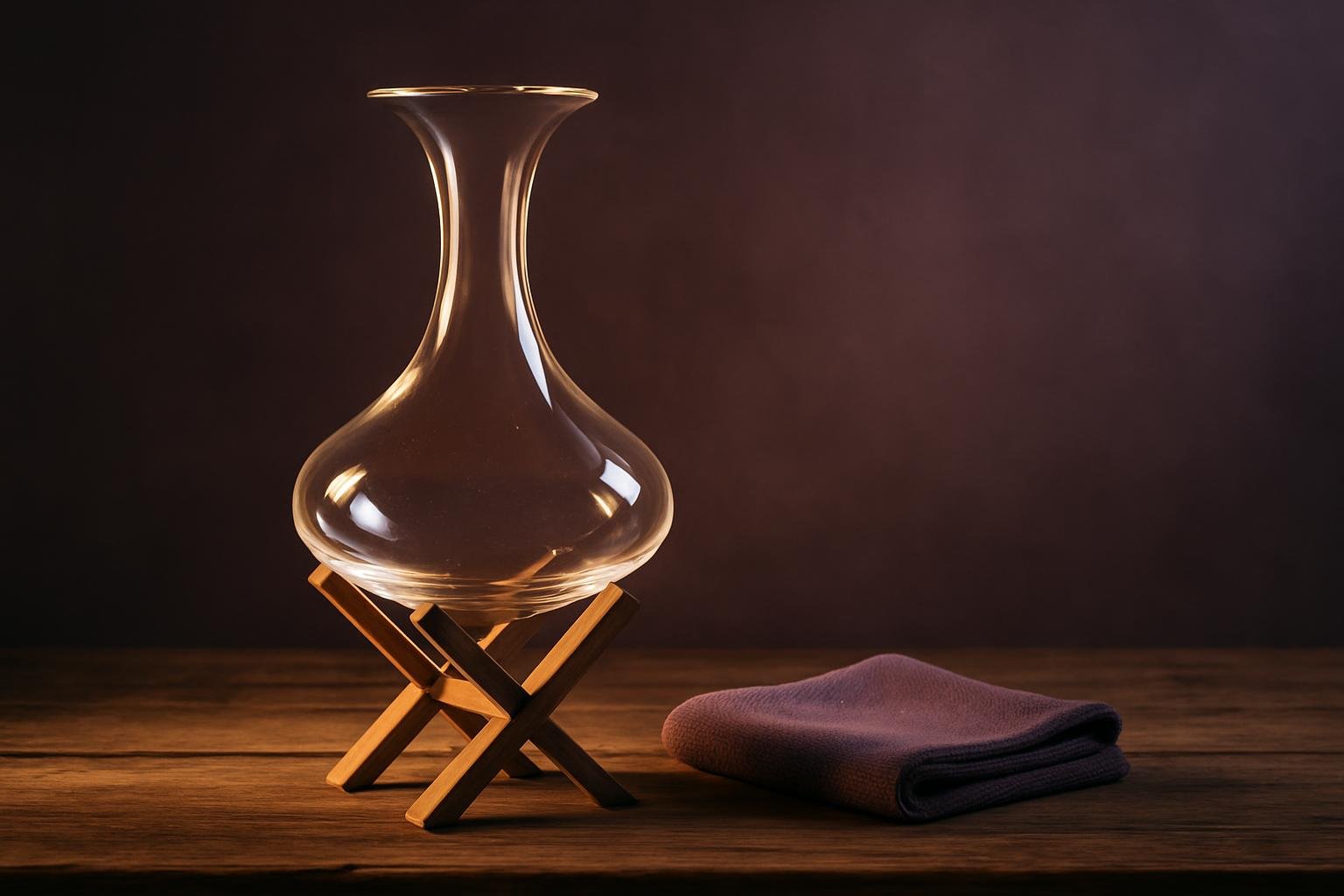
A decanter drying stand is a peg on a weighted base. The decanter goes on upside down, tilted slightly, so water runs out and air runs in. That airflow is the whole trick, because a decanter stood neck down in the sink dries very slowly indeed.
Buy one that is tall enough for your decanter and heavy enough not to tip. Give it four to eight hours and the job is done with no cloth touching the glass.
The Paper Towel Wick
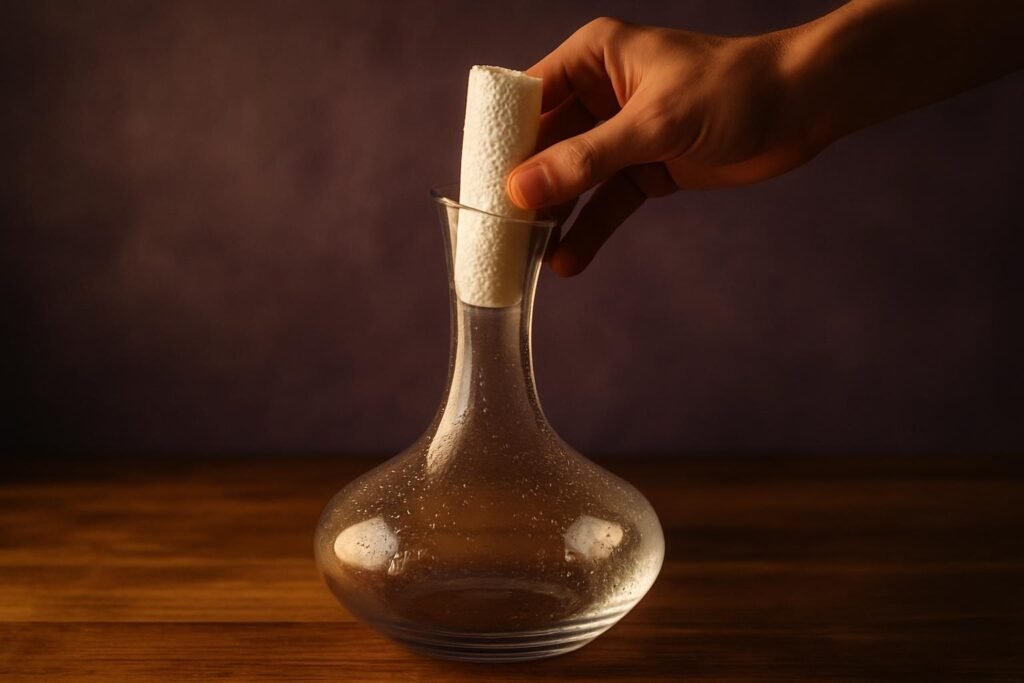
No stand? Take a sheet of lint-free kitchen paper, twist it into a rope, and feed it down the neck until it touches the base. It draws the last of the water up and out. Swap it for a fresh one after ten minutes and leave the second one in place.
Use lint-free paper or a clean microfibre cloth. Ordinary tea towels shed fibres, and fishing them back out of a narrow neck is a slow and undignified job.
A Hairdryer on Cool
Hold a hairdryer on its lowest heat at the neck and let the moving air do the work. Ten minutes is usually plenty. Keep it on cool or warm, never hot, because a sudden temperature change can crack thin glass.
Rinse With Filtered Water
This is the step most people skip and it is the one that stops the spots. Give the clean decanter a final rinse with filtered or distilled water before you dry it. No dissolved minerals in, no white film out.
What Not to Do
- Do not put a crystal decanter in the dishwasher. The heat and detergent leave a cloudy etch that never comes off.
- Do not pour boiling water into cold glass. Warm water is enough, and it will not shock the base into a crack.
- Do not use washing-up liquid inside. The neck is too narrow to rinse properly and the residue taints the next bottle.
- Do not put the stopper back in until the decanter is completely dry. A sealed decanter with a damp base smells like a caravan in August.
- Do not store it in a cupboard while it is still cool and damp. Give it a full day on the bench first.
Pour Something Into It
A dry decanter deserves a wine that actually needs one. That means something young, dark and a bit closed when you open it, not a delicate old bottle that will fade in the air. Our decanter roundup covers which shape suits which wine, and the aerator guide covers the faster option for a weeknight.

Kalleske Moppa Barossa Valley Organic Shiraz 2024
This is the kind of wine a decanter exists for: a young Barossa Shiraz with the fruit still tightly wound. Give it an hour of air and the ripe blackberry and pepper open right up.
- Organic and biodynamic fruit from the Kalleske family block at Moppa
- Young, dark and dense, so an hour of air genuinely changes it
- Barossa Shiraz at a price that does not make you nervous about spilling
- Under $30 a bottle
- Open it, decant it, then wait. Patience is not everyone’s strong point.
Serving it well matters as much as decanting it. The glasses roundup explains why a bigger bowl helps a Shiraz, and our Shiraz guide covers the grape itself.
Frequently Asked Questions
How do I dry the inside of a wine decanter?
Drain it, shake it hard over the sink, then either stand it upside down on a drying stand or feed a rolled lint-free paper towel down the neck to wick out the last drops. Both work. The stand takes longer and touches nothing.
How long does a decanter take to air dry?
Upside down on a stand, four to eight hours. Standing upright on the bench, a day or more, because water collects in the base and has nowhere to go. A hairdryer on cool cuts it to about ten minutes.
Why does my decanter have white spots after drying?
Hard tap water. The water evaporates and leaves its dissolved calcium and magnesium behind as limescale. Rinse with filtered or distilled water before drying and the spots stop appearing.
Can I put my decanter in the dishwasher?
Only if it is plain glass, the maker says it is dishwasher safe, and your machine has a stemware setting. Crystal should always be washed by hand, because dishwasher detergent etches it permanently.
Should I store my decanter with the stopper in?
No. A stopper traps whatever moisture is left and the decanter starts to smell stale. Store it dry, uncovered and upright, and put the stopper beside it.
Do I need to dry a decanter if I am using it again tomorrow?
Yes. Even a small amount of standing water grows a musty smell overnight, and that smell transfers straight into the next wine. Drying takes two minutes of effort.
If you are weighing up a wide-bowled decanter, our Riedel Ultra decanter review looks at whether the shape earns its price.
This post contains affiliate links. If you buy through them we earn a small commission at no extra cost to you. It keeps the wine flowing and the reviews honest.