Heads up: this guide contains an affiliate link. If you buy through it we earn a small commission at no extra cost to you.
The five S’s of wine tasting are See, Swirl, Sniff, Sip and Savour. They are a checklist for slowing down, and every step has a physical reason behind it. Work through them once with a glass in your hand and the wine tells you more than it did five minutes ago.
The step most people skip in a hurry is the one that matters most. Your tongue only reports five things: sweet, salty, sour, bitter and umami. Everything else you think you are tasting, the blackcurrant, the vanilla, the wet stone, reaches you through your nose from the back of your mouth. Swirling and sniffing are not theatre. They are most of the tasting.
Table of Contents
The Five S’s at a Glance
| Step | What you do | What it actually tells you |
|---|---|---|
| See | Tilt the glass over something white and look at the rim | Rough age, and whether something is wrong |
| Swirl | Roll the glass on the table for about five seconds | Nothing by itself; it sets up the next step |
| Sniff | Two or three short sniffs, nose just inside the rim | Fruit, oak, age, and most faults |
| Sip | A small mouthful held for three or four seconds | Sweetness, acidity, tannin, body, alcohol |
| Savour | Swallow, then count how long the flavour lasts | Quality and balance, more honestly than anything above |
Working Through the Five S’s
1. See
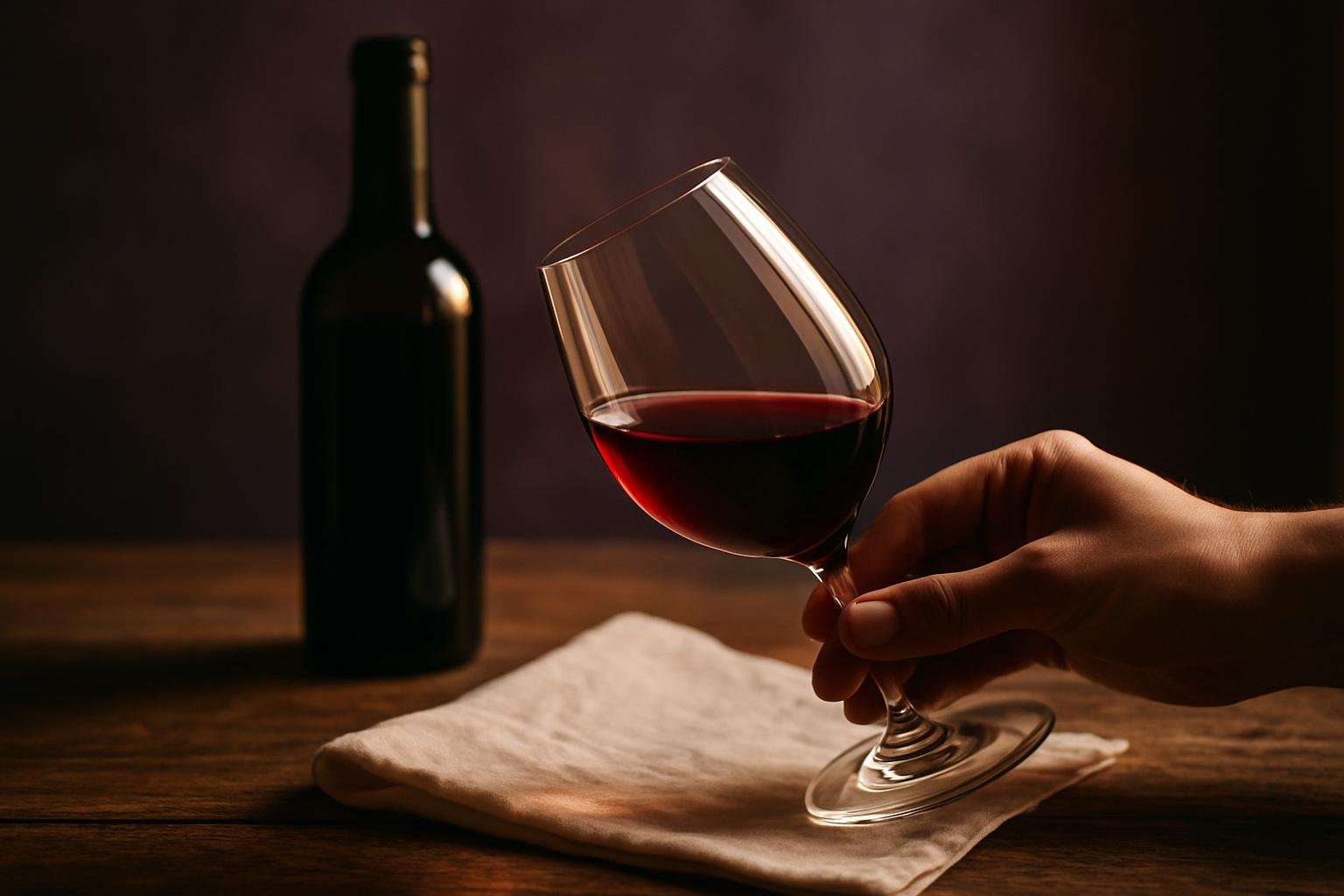
Tilt the glass to about 45 degrees over a white napkin and look at the edge rather than the middle, because the rim is where the information sits. Young reds are purple at the edge and turn brick or tawny with age. Whites travel the other way, from near-colourless with a green tint towards deep gold. Cloudiness in a wine that is not deliberately unfiltered is a warning sign, and so is a brown edge on a young red. That is close to everything colour can tell you, which is less than most people hope.
2. Swirl
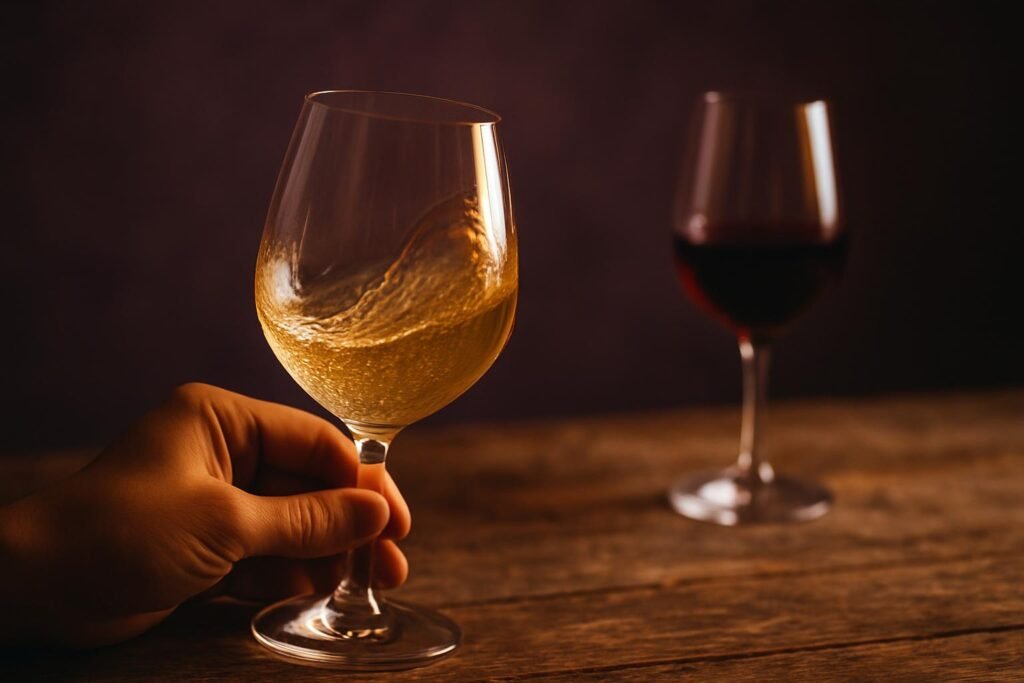
Swirling does exactly one job. It spreads the wine up the side of the glass, which increases the surface area and lets the volatile aroma compounds evaporate into the space under your nose. Five seconds is plenty. Keep the base on the table until you trust yourself, because the alternative is a lap full of Shiraz. The legs that run back down the glass tell you about alcohol and sugar, not quality, whatever the confident person at the table says. If a young red still smells shut after a good swirl, a decanter or an aerator does the same job on a larger scale.
3. Sniff
Put your nose just inside the rim and take two or three short sniffs rather than one long one, because smell receptors tire quickly. Then stop and name one thing. One is enough to begin with. Look for fruit first, then for anything that is not fruit: vanilla and coconut mean oak, a buttery note means malolactic fermentation, honey and nuts usually mean age. Most faults show up here too. Wet cardboard means cork taint, nail polish remover means volatile acidity, and a struck-match smell is usually sulphur that will blow off in ten minutes.
4. Sip
Take a small mouthful, about a tablespoon, and hold it for three or four seconds before you swallow. You are not hunting for flavour names at this point. You are checking structure: sweetness, sourness (that is acidity), bitterness and the drying grip of tannin. Those are the things your tongue can genuinely report. If you are unsure whether a wine is sweet or simply fruity, our guide to off-dry wine sorts out the difference.
Then do the part almost nobody is taught. With the wine still in your mouth, breathe out gently through your nose. That pushes the aroma compounds up into your nasal cavity from behind, which is where the flavour you have been chasing actually lives.
5. Savour
Swallow, say nothing, and count. The number of seconds the flavour hangs about is called the finish, and it is the most honest quality signal in the whole ritual. Inexpensive wine tends to disappear in two or three seconds. A good bottle carries on for fifteen or more, and shifts as it goes. Then ask one question: do I want another sip? That question has settled more purchases than any tasting note ever written.
Two Myths the Ritual Carries
The tongue map
You may have been shown a diagram with sweet at the tip, bitter at the back and sour along the sides, then told to swish wine around to hit the right zones. It is not true. The map came from a 1942 Harvard textbook by Edwin Boring, who re-plotted a 1901 German paper by David Hänig and turned tiny differences in detection thresholds into apparent no-go areas. Virginia Collings tested it properly in 1974 and confirmed that every part of the tongue detects every taste. Some spots notice a taste slightly sooner than others, but nowhere is deaf to anything. Swish the wine because it warms it and coats your mouth, not because you are aiming at a target.
Swirling and sniffing are just showing off
They are the opposite of showing off. Taste, strictly speaking, has five dimensions, and telling an apple from a pear needs the nose, never mind telling a Barossa Shiraz from a Coonawarra Cabernet. The psychologist Paul Rozin drew the line in 1982 between orthonasal smell, which is breathing in, and retronasal smell, which is breathing out. He trained people to identify smells through the nostrils, then watched their accuracy collapse when the same smells arrived at the back of the mouth. Pinch your nose and take a sip if you want the demonstration at home. The wine shrinks to sour, bitter and warm.
Practise on One Bottle
The quickest way to learn this is to run all five steps on a wine with loud, obvious aromatics, then try the same routine on something subtle a week later. A young Sauvignon Blanc is the best teaching bottle there is, because it more or less shouts its aromas at you and gives a beginner something to actually name.

Babydoll Sauvignon Blanc
Pour two glasses, do the five steps on this one, then repeat on whatever else is open. The contrast teaches you far more than either glass does alone.
- Loud, easy-to-name aromas of passionfruit and grapefruit
- Fresh acidity, so the structure step is obvious too
- Under twenty dollars, so no pressure to be reverent
- Vegan and gluten free, if that matters at your table
- Subtle it is not, so it will not teach you patience
Frequently Asked Questions
What are the 5 S’s of wine tasting?
See, Swirl, Sniff, Sip and Savour. Look at the colour at the rim, swirl to release the aromas, sniff in short bursts, sip and check the structure, then swallow and time the finish.
Do I have to spit?
Only when there is a lot to get through. At a cellar door with ten wines lined up, spitting is completely normal and nobody will blink. At home with one bottle, swallow, because the finish is part of the assessment.
Does the shape of the glass matter?
More than you would think. A bowl wide enough to swirl in and a rim that narrows towards your nose does half the work of the first three steps. Our guide to wine glasses covers which shapes are worth owning.
How long should I swirl for?
About five seconds. Longer does not release more aroma, it just risks the tablecloth. If the wine still smells closed, give it ten minutes in the glass instead.
Why can I smell things in wine that I cannot taste?
Because taste and flavour are different systems. Your tongue handles sweet, salty, sour, bitter and umami, and everything else arrives through your nose. That is why a heavy cold flattens a good bottle into sour and warm.
Can anyone learn this, or do you need a gift for it?
Almost anyone can learn it. The trick is naming one thing per glass rather than trying to produce a paragraph. Ten bottles in, you will have a working vocabulary; a hundred in, you will start recognising regions.
This post contains affiliate links. If you buy through them we earn a small commission at no extra cost to you. It keeps the wine flowing and the reviews honest.