Grenache and Mourvèdre are two-thirds of a GSM, the Grenache Shiraz Mourvèdre blend that is South Australia’s answer to the southern Rhône. They are both Spanish by birth, both love heat, and both spent a century in Australia as anonymous fortified-wine grapes before anyone put their names on a label. Beyond that they could not be more different. Grenache is the fruit and the perfume; Mourvèdre, which Australians usually call Mataro, is the muscle and the funk. Here is what each one brings and what they taste like on their own.
Table of Contents
The short version
| Grenache | Mourvèdre (Mataro, Monastrell) | |
|---|---|---|
| Origin | Spain (Garnacha), Aragon | Spain (Monastrell), the Mediterranean coast |
| Colour | Pale to medium; fades fast | Deep, dark |
| Smells of | Raspberry, strawberry, white pepper, dried herbs | Blackberry, game, leather, earth, black pepper, sometimes a barnyard note |
| Body | Medium, silky | Full, chewy |
| Tannin | Low to medium, fine | High, firm |
| Alcohol | High; 14.5 per cent and up is normal | High, but it hides it better |
| Ripens | Late | Later still; needs the hottest sites |
| Role in a GSM | The fruit, the perfume, the softness | The colour, the tannin, the savoury depth |
| Famous on its own in | Châteauneuf-du-Pape, Priorat, McLaren Vale, Barossa | Bandol, Jumilla, Barossa |
| Serve at | 14 to 16°C; a light chill suits it | 16 to 18°C |
Grenache: the fruit
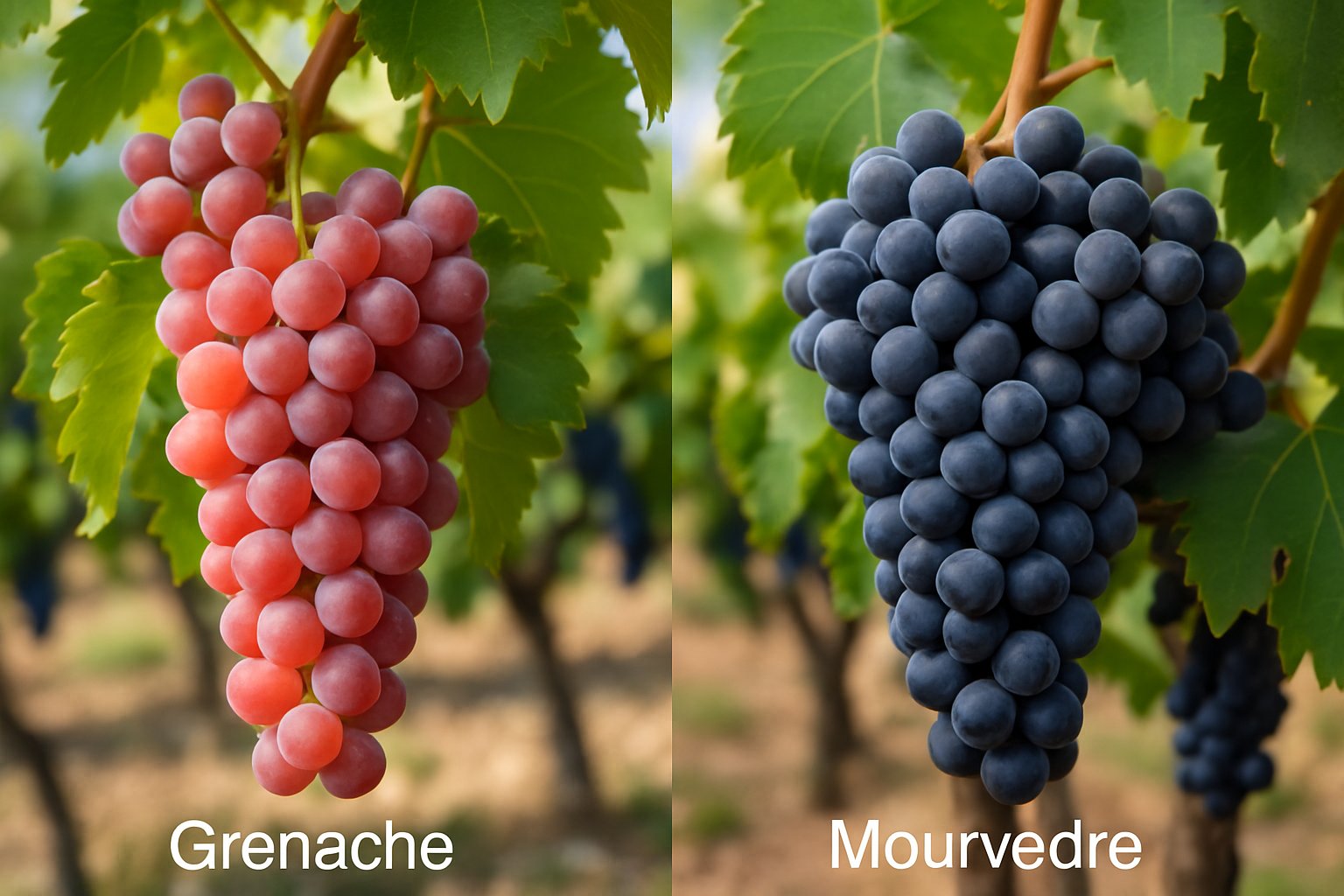
Grenache is a big, thin-skinned grape from Aragon in north-east Spain that spread along the Mediterranean and into the southern Rhône, where it is the main grape of Châteauneuf-du-Pape. It makes a wine that is pale, fragrant and full of red fruit, raspberry and strawberry, with white pepper and dried herbs, and it carries alcohol without tasting hot. Its tannin is soft and its acid is low, so it is silky rather than grippy. On its own it can taste like a warm-climate Pinot Noir; in a blend it fills in the middle and makes everything friendlier. For most of the twentieth century Australia grew it by the hectare for fortified wine and cheap blends, then pulled it out when tastes changed. The vines that survived, some more than a century old and never irrigated, now make some of the country’s most exciting reds, especially in McLaren Vale and the Barossa. Our McLaren Vale guide tells that story.
Mourvèdre: the muscle
Mourvèdre is a small, thick-skinned, late-ripening grape from the Spanish coast, where it is called Monastrell and is still the country’s fourth most planted red. The French call it Mourvèdre and make it the backbone of Bandol, on the coast east of Marseille, where the reds must be at least half Mourvèdre. Australians and Californians call it Mataro. It needs, in the old saying, its face in the hot sun and its feet in the water: serious heat to ripen, and a water table or irrigation so it does not shut down. The wine is dark, tannic and full, with blackberry fruit under layers of game, leather, earth and black pepper, and a wild, almost meaty edge that people either love or find a bit much. In a blend it gives colour, grip and depth; on its own it needs food and a few years.
It came to Australia in James Busby’s 1830s cuttings and was planted by the Lutheran settlers of the Barossa, and some of the oldest continually producing Mataro vines anywhere are in the Barossa, the Riverina and the Riverland. Like Grenache, it was a fortified-wine workhorse that has been rediscovered.
Why they are blended
Each one fixes the other. Grenache is pale, soft and high in alcohol; Mourvèdre is dark, tannic and savoury. Put them together with Shiraz for the middle and you get a wine with colour, fruit, structure and perfume that none of the three has alone. That is the southern Rhône formula, and it is why GSM is the Barossa’s and McLaren Vale’s most useful red: cheaper than straight Shiraz, more interesting, and ready sooner. The share of each grape tells you the style. Grenache-led blends are lighter and prettier; Mourvèdre-heavy ones are darker and more serious.
What to buy
Grenache prices are Dan Murphy’s shelf prices on 9 September 2026 and will move about; BWS stocks many of the same names. Mourvèdre is named without prices because so little of it is sold on its own.
| Wine | Price band | Why |
|---|---|---|
| d’Arenberg The Stump Jump GSM | About $14 | The cheapest honest GSM in the country |
| d’Arenberg d’Arry’s Original Grenache Shiraz | About $16 to $20 | McLaren Vale’s classic blend since the 1950s |
| d’Arenberg The Custodian Grenache | About $20 | Old-vine Vale Grenache on its own, at a fair price |
| Chapel Hill Vinedresser Grenache | About $25 | The fragrant modern style |
| Oliver’s Taranga Grenache | About $33 | Sixth-generation family; one of the Vale’s best |
| A Barossa Mataro (Hewitson Old Garden, Turkey Flat, Yalumba, Teusner) | Dan Murphy’s or an independent | Old-vine Mourvèdre on its own; dark, savoury, worth knowing |
| A Bandol (Domaine Tempier, Château de Pibarnon) | Dan Murphy’s or an independent | The world benchmark for Mourvèdre; expensive and worth it once |
| A Jumilla Monastrell from Spain | Dan Murphy’s or an independent | The cheap way to taste the grape; ripe, dark, generous |
Our Grenache guide and Mourvèdre guide cover each grape in full.
Heads up: the boxes below link to Just Wines, our partner shop. If you buy through them we earn a small commission at no extra cost to you. Prices were checked when this was written and move about.
Honesty corner: the partner shop had no straight Mataro when we checked. The Grenache side, and the blend that has both:

Murray Street Wines Greenock Estate Barossa Valley Grenache 2020
- Barossa Grenache from vines planted in 1948 and 1970 at Greenock
- Varietal purity and structure from ancient soils
- About twenty-five dollars, well under its sixty-dollar full price at the time of writing
- A 2020, so drink it in the next couple of years

Sherrah South Australia Preservative Free Grenache 2025
- Small-batch, preservative-free Grenache from a McLaren Vale winemaker
- The modern, fragrant style; serve it a little cool
- About twenty-five dollars
- Preservative-free; drink it young

Fox Creek Postmaster McLaren Vale GSM 2021
- Old-vine Grenache, Shiraz and Mourvèdre from a McLaren Vale family estate
- The region's classic blend from the excellent 2021 vintage
- About twenty-nine dollars
- A blend, so the Mataro is a supporting act
For a straight Mataro, BWS and Dan Murphy’s carry Barossa versions from Hewitson, Turkey Flat and Yalumba when they have them in.
What to eat with them
Grenache is the flexible one: roast chicken, pork, duck, charcuterie, mushroom risotto, a mild curry, and it is one of the few reds that suits a light chill on a hot day. Mourvèdre wants richer, meatier food to soften it: slow-cooked lamb, beef stew, game, sausages off the grill, a strong cheese. A GSM sits in between and is the safest red for a barbecue with mixed food. Serve Grenache at 14 to 16°C and Mourvèdre a little warmer.
Frequently asked questions
Is Mataro the same as Mourvèdre?
Yes. Mourvèdre is the French name, Monastrell the Spanish, and Mataro the name used in Australia, Portugal and California. One grape, three names.
What does GSM stand for?
Grenache, Shiraz (Syrah) and Mourvèdre, the three grapes of the southern Rhône blend, which the Barossa and McLaren Vale have made their own.
Which is lighter, Grenache or Mourvèdre?
Grenache, by a long way. It is pale, soft and red-fruited. Mourvèdre is dark, tannic and savoury.
Why is Grenache so high in alcohol?
It ripens late and builds sugar fast in warm places, so 14.5 to 15.5 per cent is normal. The soft tannin and red fruit stop it tasting hot.
Why is old-vine Grenache special?
Old, dry-grown vines give small crops of intense fruit, and Australia has some of the oldest Grenache vines in the world because nobody bothered to pull them out. Made lightly, the wine is fragrant, spicy and silky rather than jammy.
What is Bandol?
A small region on the French Mediterranean coast whose reds must be at least half Mourvèdre. It is the world’s benchmark for the grape: dark, savoury, long-lived, and one of France’s best rosés as well.