Heads up: this guide contains an affiliate link. If you buy through it we earn a small commission at no extra cost to you.
Touriga Nacional is Portugal’s national grape, and it earns the name. It is the backbone of great vintage port, the heart of the Douro’s best dry reds, and a vine so stubborn and low-yielding that growers nearly gave up on it in the 1970s. Then someone tasted what those tiny, thick-skinned berries could do, and Touriga went from problem child to national treasure.
It is dark, floral and powerful, with a perfume of violets and bergamot that no other big red quite matches. Australia knows it well: our fortified winemakers have used it for decades, and now it is turning up as a dry table wine from McLaren Vale to the Yarra.
Table of Contents
What Does Touriga Nacional Taste Like?
Blackberry, blueberry and black plum, wrapped in violets, rose, bergamot and Earl Grey tea, with liquorice, black pepper and a savoury, mineral edge. It is deeply coloured, full-bodied, firmly tannic and fresh enough to age for decades. In port it turns into dried fruit, chocolate and spice; as a dry red it is a floral heavyweight.
| Aspect | Rating out of 5 | Characteristic |
|---|---|---|
| Sweetness | 🍷 | Dry as a table wine; port is another story |
| Body | 🍷🍷🍷🍷🍷 | Full and powerful, the national heavyweight |
| Tannins | 🍷🍷🍷🍷🍷 | Firm and structured, built for the cellar |
| Acidity | 🍷🍷🍷🍷 | Fresh, the reason it ages so well |
| Alcohol by Volume | 🍷🍷🍷🍷 | Typically 13.5–14.5% dry; 19–20% as port |
Each wine glass icon is one point on a 5-point scale: one glass is low, five is high, based on the grape’s typical style.
Where It Grows
The Douro Valley in northern Portugal is home, on steep schist terraces above the river where port has been made for three centuries. The Dão region to the south is its original birthplace and makes more elegant, perfumed versions. It is now planted across Portugal and, in small amounts, in Spain, California and South Africa.
Australia has grown Touriga since the 1800s for fortified wine, mostly in Rutherglen, the Barossa and the Riverland, where our “Australian port” tradition needed Portuguese grapes. The modern twist is dry Touriga: McLaren Vale, the Barossa, the Yarra Valley and Heathcote all make it now, and it suits our warm, dry conditions beautifully.
How to Serve It
Temperature: 16–18°C for dry reds. Port at 14–16°C.
Glass: a big Bordeaux bowl for the dry wine; see the glasses roundup.
Decanting: yes, an hour in a decanter for young dry Touriga. Vintage port needs decanting off its sediment; our Riedel decanter review covers a suitable one.
Ageing: dry Touriga improves for five to fifteen years. Vintage port can go fifty.
What to Eat With It
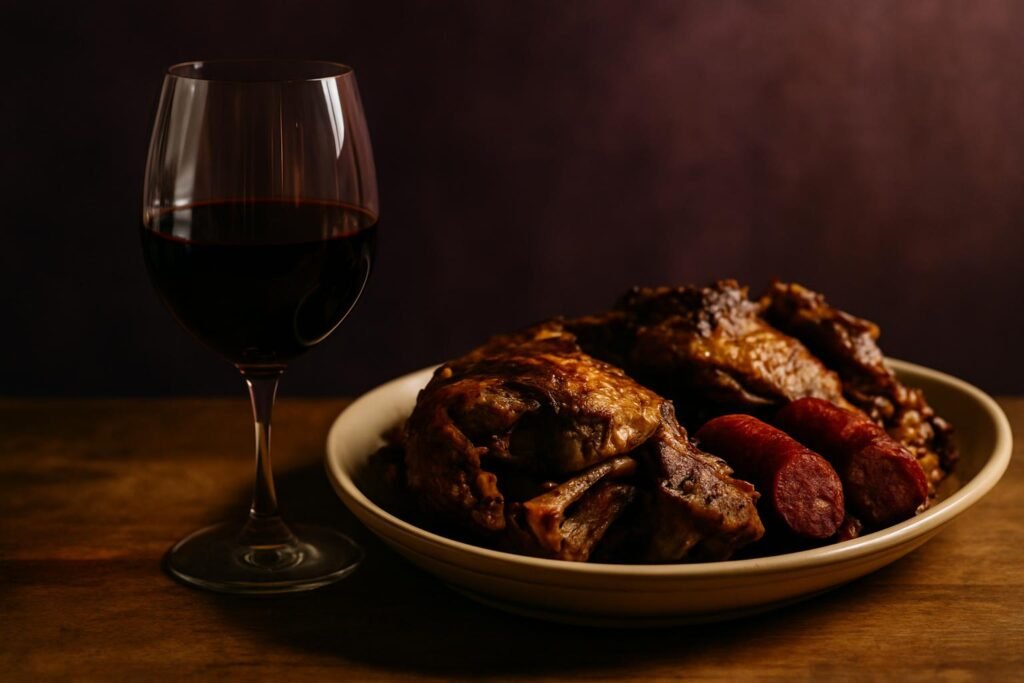
Roast lamb, beef, goat, game and Portuguese classics like chouriço and slow-cooked pork. Bacon and smoky barbecue suit it too. As port: blue cheese, dark chocolate and tiramisu. More in the pairing guides.
Celebrated Wine Labels
| Wine Label | Country | Style |
|---|---|---|
| Quinta do Noval | Portugal | Vintage port royalty, Nacional is the legend |
| Quinta do Crasto | Portugal | Douro dry reds, rich and polished |
| Niepoort | Portugal | Port and Douro reds with a modern edge |
| Quinta dos Roques | Portugal | Dão, elegant single-varietal Touriga |
| Seppeltsfield | Australia | Barossa fortified tradition with Portuguese grapes |
Drink One Tonight

Wild Folk Natural Preservative Free Touriga Nacional 2022
Portugal’s national grape, grown in Australia and bottled without fuss. Decant it, roast something, and see what the fuss is about.
- Real Touriga Nacional, as a dry table red
- Organically grown, preservative free, minimal intervention
- Violets, dark fruit and grip, true to the grape
- A rare chance to try dry Australian Touriga under twenty-five dollars
- Natural-wine style; a little wilder than a polished Douro red
New to Just Wines? The code FIRST20 takes $20 off a first order over $99, so it is worth building a mixed six rather than buying the one bottle. New customers only, and the offer can change without notice.
Frequently Asked Questions
What does Touriga Nacional taste like?
Dark berries, violets, bergamot and black pepper, with firm tannin and fresh acidity. In port it becomes rich, sweet and spicy; as a dry red it is a floral, structured heavyweight.
Is Touriga Nacional only used for port?
Not any more. It is the top port grape, but since the 1990s the Douro and Dão have made superb dry reds from it, and Australia is following.
How do you pronounce Touriga Nacional?
Too-REE-ga nah-see-oh-NAHL.
What is Touriga Nacional similar to?
Cabernet Sauvignon for structure and Shiraz for dark fruit, with a floral lift closer to Malbec. Read our Shiraz guide for the nearest Australian match.
Does Australia grow Touriga Nacional?
Yes, for over a century in fortified wine, and increasingly as a dry red from McLaren Vale, the Barossa, the Yarra Valley, Heathcote and Rutherglen.
This post contains affiliate links. If you buy through them we earn a small commission at no extra cost to you. It keeps the wine flowing and the reviews honest.