Yes, every vermouth contains sugar, because sugar is what makes wormwood drinkable. How much depends entirely on the style. Dry vermouth carries under fifty grams per litre, and sweet vermouth carries a hundred and thirty grams per litre or more.
The good news is that the numbers are set by law rather than by marketing, so once you know the five categories you can read any bottle in a second.
Table of Contents
How Much Sugar Is in Vermouth?
Vermouth is an aromatised wine, and in Europe its labelling is governed by Regulation (EU) No 251/2014. Article 6 sets out exactly what each sweetness word on the label is allowed to mean, measured as invert sugar:
| Label term | Sugar per litre | Also required |
|---|---|---|
| Extra-dry | Less than 30 g | At least 15 per cent alcohol |
| Dry | Less than 50 g | At least 16 per cent alcohol |
| Semi-dry | 50 g to under 90 g | No extra rule |
| Semi-sweet | 90 g to under 130 g | May state the exact figure |
| Sweet | 130 g or more | May state the exact figure |
Most vermouth on Australian shelves comes from Italy, France or Spain, so it is made to these rules. Australian producers are not bound by them, but nearly everyone borrows the same vocabulary because that is what drinkers expect. Note that the regulation only says what the words mean. A producer is free to print none of them, and plenty do exactly that.
What That Means in Your Glass
Grams per litre is a laboratory number. Here is the useful version, based on a sixty millilitre pour, which is the standard measure in a Negroni or a Manhattan.
- Dry vermouth at around thirty grams per litre gives you about 1.8 grams of sugar per sixty millilitres. That is under half a teaspoon.
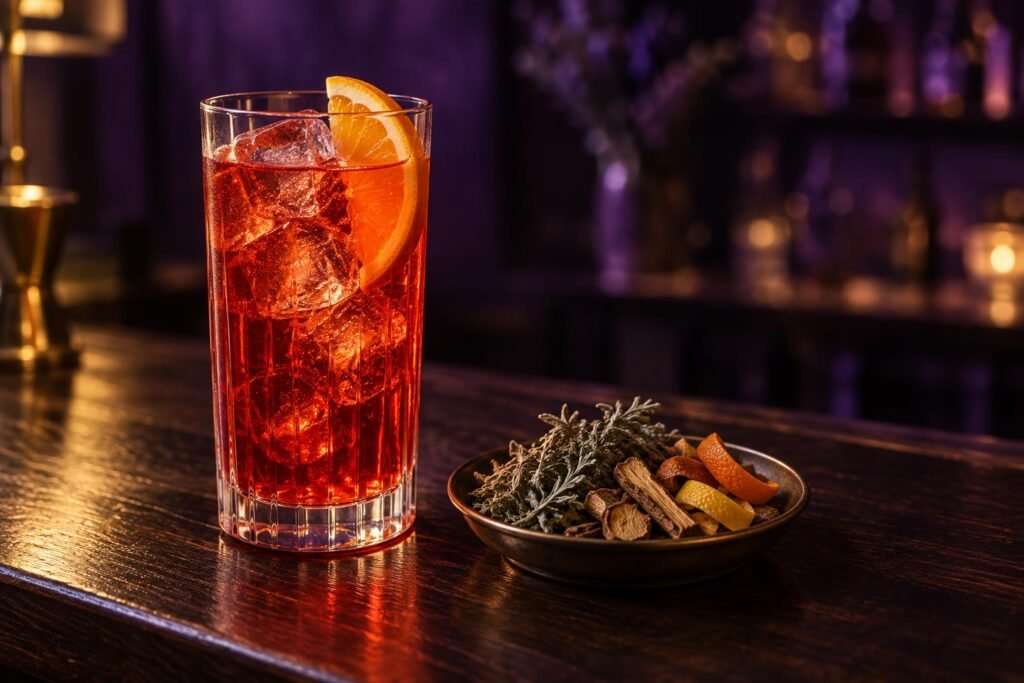
- Sweet red vermouth at around a hundred and fifty grams per litre gives you about nine grams per sixty millilitres. That is a bit over two teaspoons.
- Bianco or blanc vermouth usually lands in the semi-sweet band, so call it five to seven grams per pour.
So the honest headline is that a Martini made with dry vermouth carries almost no sugar, and a Negroni carries a couple of teaspoons before you count the Campari. Neither is a health food, but the gap between them is real.
Why Vermouth Has Sugar at All
Vermouth is defined by wormwood, from the Artemisia family, and wormwood is properly bitter. Add the gentian, quinine and assorted roots that most recipes include, and an unsweetened version would taste like cough medicine that had given up on itself.
Sugar does three jobs. It balances that bitterness so the herbs read as complex rather than punishing. It adds body, so the drink feels like something instead of thin fortified wine. And it works as a mild preservative alongside the added spirit, which is part of why an opened bottle lasts longer than table wine. Not forever, though, and our guide to storing and freezing vermouth explains how long you really have.
The Styles, Sweetest to Driest
Sweet red (rosso, Italian style)
The Negroni and Manhattan bottle. A hundred and thirty grams of sugar per litre at minimum, often a good deal more, with caramel colouring and a rich cola-and-orange-peel flavour. This is the sweetest thing in the category.
Bianco and blanc
Clear or pale gold, sweet but lighter than rosso, usually in the semi-sweet band. Vanilla, elderflower and citrus. Very good over ice with soda and a slice of orange, which is the drink more Australians should be making in summer.
Rosé and rosato
A newer style, pink, floral and moderately sweet. Sugar levels vary a lot between producers, so this is the one where you really do need to read the label.
Dry (French style)
Pale, herbal and slightly saline, under fifty grams per litre and legally at least sixteen per cent alcohol. This is the Martini bottle, and the one to reach for if sugar is your concern.
Extra-dry
Under thirty grams per litre. Rarer on the shelf, and worth hunting down if you like a bracing Martini or you simply want the herbs without the sweetness.
What About Calories?
This is where people get a surprise. Alcohol carries about seven calories per gram and sugar about four, so a drier, stronger vermouth is not automatically the lighter choice.
Run the arithmetic on a sixty millilitre pour. Sweet vermouth at fifteen per cent alcohol gives you roughly fifty calories from the alcohol and about thirty-five from the sugar, so around eighty-five in total. Dry vermouth at eighteen per cent gives you roughly sixty calories from the alcohol and only seven from the sugar, so around sixty-five. Dry still wins, but by less than most people assume, because the extra alcohol claws back most of the saving.
Alcohol is worth watching for its own sake. A sixty millilitre pour at sixteen per cent is about three quarters of an Australian standard drink, which adds up quickly across a few rounds. If you want to compare that with a normal glass of wine, our wine calorie calculator does the sums for you.
If You Are Trying to Cut the Sugar
- Switch the drink, not just the bottle. A Martini or a vermouth and soda has a fraction of the sugar of a Negroni.
- Read the actual number. Semi-sweet and sweet bottles are allowed to print grams of invert sugar per litre, and producers who are proud of a lower figure usually say so.
- Stretch it. Vermouth over ice with soda water and a twist gives you a long drink from a small pour, which is how it is drunk in Spain and Italy anyway. The Americano is the classic version.
- Do not assume alcohol-free versions have less sugar. Many add more to replace the body the alcohol used to give, so check the panel.
Frequently Asked Questions
Does dry vermouth have sugar?
Yes, but not much. Dry vermouth is legally under fifty grams per litre and most sit closer to thirty. That works out at under two grams in a standard sixty millilitre pour, which is less than half a teaspoon.
How much sugar is in sweet vermouth?
At least a hundred and thirty grams per litre, and often around a hundred and fifty. In a sixty millilitre pour that is roughly nine grams, or a little over two teaspoons.
Is vermouth high in sugar compared with wine?
Yes, considerably. A dry table wine usually has under four grams of residual sugar per litre. Sweet vermouth has thirty or forty times that, which puts it closer to port than to a glass of Shiraz.
Is there a sugar-free vermouth?
Not really. Sugar is structural here, both for taste and for balance against the wormwood, so a genuinely sugar-free version would not be vermouth in any meaningful sense. Extra-dry, at under thirty grams per litre, is as low as the category goes.
Does vermouth affect blood sugar?
A sweet vermouth carries a meaningful amount of sugar, so it can. Alcohol also changes the way the liver releases glucose, which complicates the picture further. If you are managing diabetes, that is a question for your doctor rather than a wine blog.
What is vermouth actually made of?
A base of fairly neutral wine, extra alcohol, sugar, and a mix of botanicals that must include wormwood from the Artemisia family. Our explainer on what vermouth is walks through the whole process.