Heads up: this guide contains an affiliate link. If you buy through it we earn a small commission at no extra cost to you.
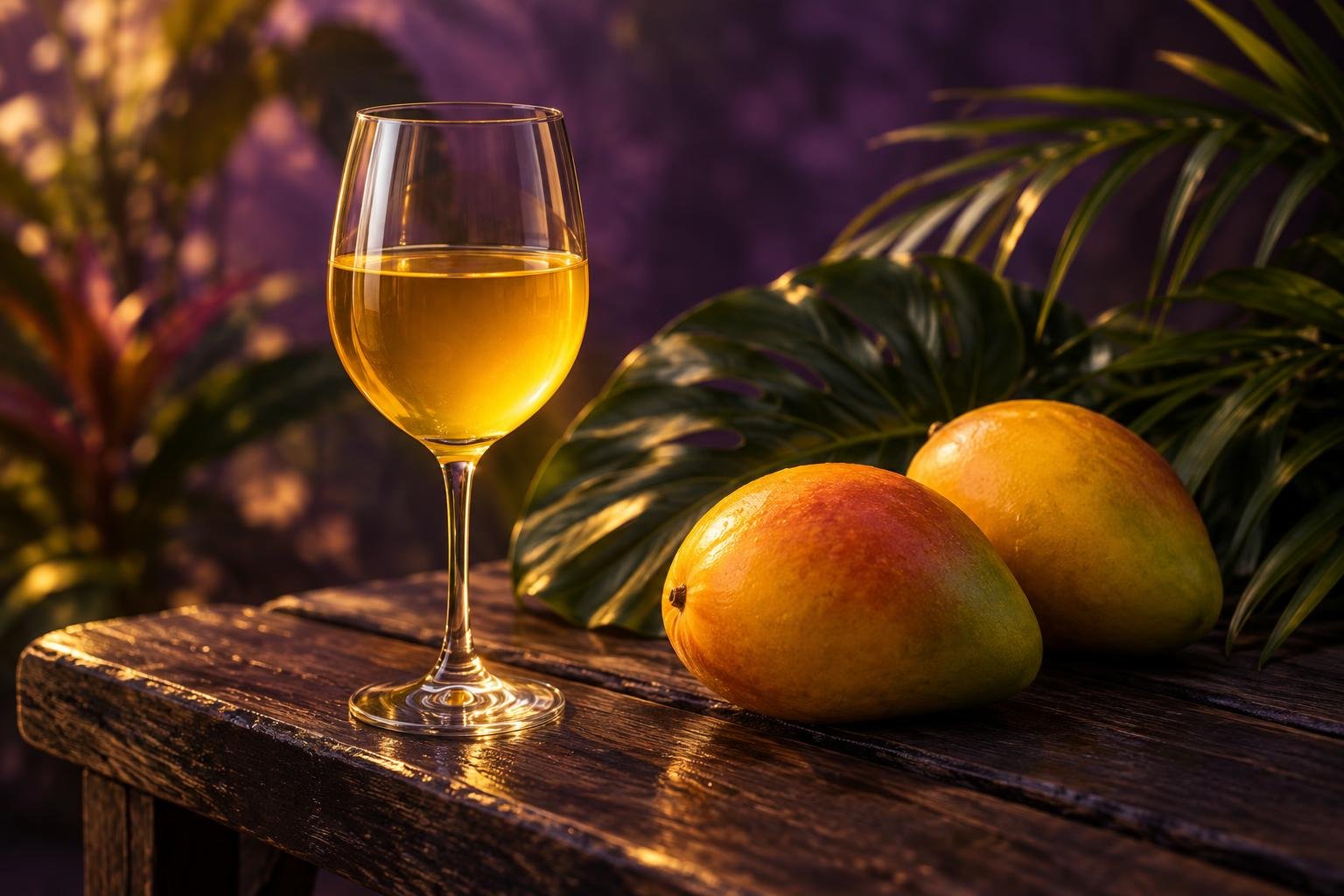
Mango wine is a fruit wine made by fermenting mango pulp instead of grape juice. It usually lands between about 6 and 12 per cent alcohol, it is sold dry, medium or sweet, and in Australia it comes mostly from Far North Queensland.
Here is the honest bit that the label never mentions. Mango wine does not taste very much like mango, and there is published research explaining exactly where the mango goes.
Table of Contents
The Short Answer
- It is real wine in the legal sense, just not grape wine. Same yeast, same process, different fruit.
- Strength runs roughly 6 to 12 per cent, lower than most grape wine.
- It is thicker in the mouth than grape wine, and there is a measurable reason for that.
- Fermentation destroys most of the mango aroma and builds new ones, so expect banana, pear and rose rather than a ripe Kensington Pride.
- In Australia the main producer is Golden Drop Winery near Mareeba in Far North Queensland.
Why Mango Wine Does Not Taste of Mango
A team at the National University of Singapore fermented mango juice at three different sugar levels and measured what came out. The mango smell you know comes largely from terpenes. After fermentation, those terpenes had been significantly used up by the yeast, and a set of brand new compounds had appeared in their place.
Those new compounds are the same ones that show up in grape wine: isoamyl alcohol, which smells of banana, 2-phenylethyl alcohol, which smells of roses, and a family of fruity esters. So a glass of mango wine smells like wine that has met a mango, rather than like a mango. Sweeter ferments were worse at keeping the pretty aromas, not better.
The same study explains the texture. Glycerol is the compound that makes wine feel round and slightly thick, and grape wine usually holds between 4 and 9 grams per litre. The mango wines came out between 13.4 and 15.9 grams per litre. That is why fruit wine so often feels heavier than its alcohol suggests.
How Mango Wine Is Made
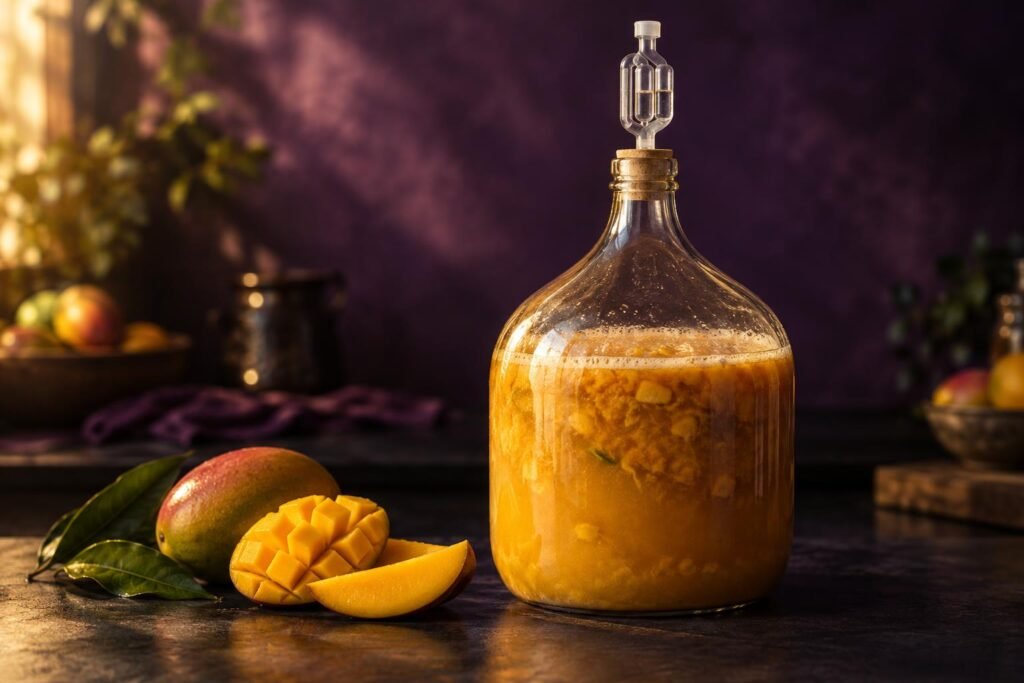
The process is grape winemaking with two extra chores. Mango has plenty of sugar, more than enough to ferment, but it is far too low in acid. In the Singapore work the mango juice came in at pH 4.55 and had to be pulled down to 3.50 with added malic acid before anything else happened. Grape juice arrives at roughly that number on its own, which is a large part of why grapes took over the job.
- Pick ripe fruit, peel it and blend the flesh into a pulp.
- Add acid to drop the pH, and usually an enzyme to break the pulp down so it will run clear.
- Sterilise the juice, normally with a small dose of sulphite, and leave it a day.
- Adjust the sugar to the strength you want, then pitch a wine yeast.
- Ferment cool, around 20 degrees, for anywhere from nine days to five weeks.
- Settle, filter and bottle. Sweeter styles keep some sugar back rather than fermenting it out.
Sugar at the start decides almost everything at the end. These are the measured results from the Singapore trial, and they are a useful guide to what any fruit winemaker is trading off.
| Starting sugar | Finished alcohol | How long it took | What it cost you |
|---|---|---|---|
| 17 Brix | 6.49 per cent | Done in about 9 days | Low strength, but the best aromatics of the three |
| 23 Brix | 9.38 per cent | Done in about 18 days | Balanced strength, weaker aromatics |
| 30 Brix | 11.51 per cent | Still not finished at 35 days | Highest strength, sluggish ferment, leftover sugar and the flattest aroma |
There is a limit worth knowing about. Fermentation makes a group of compounds called higher alcohols, and above roughly 350 milligrams per litre they start to smell harsh rather than fruity. The two sweeter ferments went past that line. The low sugar one did not, which is the strongest argument for making mango wine light rather than strong.
Where to Buy Mango Wine in Australia
Golden Drop Winery is the name almost every search leads to, and for good reason. It is a family business on a mango farm at Biboohra, about 8 kilometres north of Mareeba in Far North Queensland, and it grew out of the Nastasi family swapping tobacco for mangoes back in the 1970s.
Their wines are made only from mangoes grown on the property, and the range covers dry, medium and sweet, plus a sparkling mango wine, a mango port and a set of citrus liqueurs they call Cellos. They ship anywhere in Australia, usually within three to seven working days.
If you would rather taste before you commit, there is a cellar door on the farm and a second shop at Kuranda, the rainforest town about half an hour from Cairns. Tours run, walk ins are welcome and you do not need to book.
Making Mango Wine at Home
It is one of the easier fruit wines to attempt, and the recipes online are all variations on the six steps above. Two pieces of advice. Buy an acid testing kit rather than guessing, because the acid adjustment is the step that decides whether you get wine or vinegar. And start with a low sugar batch, because the research is clear that pushing for strength costs you flavour.
One warning. Brewing and fermenting at home for your own use is one thing. Distilling what you make into spirit is another, and it needs a licence from the tax office, so stop at wine.
Honesty Corner: What to Drink Instead
Our wine partner does not stock mango wine, and pretending otherwise would be silly. If what you actually want is that tropical, mango and stone fruit character in a glass, a grape can give it to you, and Fiano is the grape that does it best in Australia.

Gapsted Buffalo King Valley Fiano 2023
undefined
- Mango, nectarine and lemon curd character with a dry finish
- King Valley in Victoria has become the home of Italian varieties in Australia
- Around eleven dollars, which is remarkable for what is in the bottle
- It is a dry wine. If you want the sweetness of mango wine, this is not it
- Fiano is still unfamiliar, so you may have to ask for it by name
Frequently Asked Questions
What does mango wine actually taste like?
Less like mango than you expect. The yeast uses up most of the compounds that give fresh mango its smell and creates wine aromas in their place, so you get banana, pear, rose and honey with a tropical edge. Sweet styles taste more mango-ish simply because they are sweet.
How strong is mango wine?
Usually between about 6 and 12 per cent alcohol, so lower than most grape wine. The strength depends on how much sugar the winemaker started with, and pushing for higher alcohol tends to cost aroma and leave the ferment struggling.
Is mango wine sweet?
It can be any of the three. Producers usually offer dry, medium and sweet versions of the same base wine, with the sweeter ones simply stopped before all the sugar is used up. If you like Moscato, start with the medium.
What is mango sparkling wine?
The same mango wine given bubbles, either by a second fermentation or by carbonating it. Golden Drop makes one. It is a good starting point if you find still fruit wine a bit heavy, because the bubbles lift it.
Can I make mango wine at home?
Yes. Pulp the fruit, correct the acid, sterilise, add sugar if you want more strength, pitch a wine yeast and ferment cool for a few weeks. The acid step is the one that separates wine from vinegar, so buy a test kit rather than guessing.
Does mango wine go with food?
Sweeter styles work with chilli, mild curry and salty cheese, in much the same way an off dry white does. Dry mango wine is trickier and is usually better on its own, cold, on a hot afternoon. Our cheese pairing guide covers the sweet wine and salty cheese trick properly.
Sources: the fermentation figures come from Lu, Chan, Li and Liu, Effects of sugar concentration on mango wine composition fermented by Saccharomyces cerevisiae MERIT.ferm, International Journal of Food Science and Technology, volume 53, issue 1, 2018, pages 199 to 208. Producer details come from the Golden Drop Winery website.
This post contains affiliate links. If you buy through them we earn a small commission at no extra cost to you. It keeps the wine flowing and the reviews honest.